
 |
You can trust the word of any scientist on anything scientific can’t you? No, that’s a red flag. |
How to recognise this tactic
People who use this tactic try to convince you by quoting some ‘authority’ who agrees with their claims and pointing to that person’s status, position or qualifications, instead of producing real-world evidence. The tactic is known as the argument from authority.
Unthinking respect for authority is the greatest enemy of truth.
Dan Buzzard at Dan’s Journal of Skepticism sounds the alarm on a frightening example of the way bogus science can infiltrate respected media.
Sandra Lucas, a lecturer in nursing at La Trobe University in Melbourne has written an article full of pseudoscientific mumbo-jumbo and it’s been published on The Conversation. That’s a website that, until now, people have come to trust as a pretty reliable source.
As Dan points out, only academics can write for The Conversation, and it looks like the site has succumbed to one of the biggest fallacies of them all – the argument from authority. Real science doesn’t do that. It’s alarming that someone who can write an article like this can be lecturing at one of our universities.
Why would Brendan Trembath include the opinion of Meryl Dorey from the Australian Vaccination Network in a report on the emergence of a new strain of whooping cough bacteria? Looks like another case of false balance in the media to me.
The AVN has been totally discredited (see here and here). Meryl Dorey has conducted no scientific studies on diseases or vaccines. She is merely a vocal critic of vaccination. Why would she be quoted along with scientists who have actually researched these topics? Yes, it’s the old mantra of “supplying balance”.
Brendan, if you really think there is a legitimate “other side” to this issue (I don’t), why not find someone who can comment on it from a proper scientific foundation?
Jo Chandler in the Sydney Morning Herald shows how to write an intelligent article on climate change. Reporting the facts without hysteria, giving a clear and accurate analysis of the background, and above all, not feeling the need to resort to fake “balance” by running to Ian Plimer or Bob Carter for the “other side” of the argument.
Well done Jo. Not so well done to for whoever wrote the nonsensical headline “Perfect storm erupts over new climate data”.
|
Where there’s smoke, there’s fire, So if there’s no smoke, does it mean there’s a conspiracy to hide the fire, or is this a red flag? |
How to recognise this tactic
Conspiracy theorists usually start by targeting weaknesses in an accepted model, then propose a conspiracy that explains why their ‘better’ model has been suppressed. Although there can be overwhelming evidence favouring the accepted model, they claim that this simply means the conspiracy has been successful. Likewise, they see lack of any evidence for a conspiracy as demonstrating how clever the conspirators are. As time goes on, more and more people need to be added to the conspiracy to explain why it is not exposed.
A conspiracy theory gives believers someone tangible to blame for their perceived predicament, instead of blaming it on impersonal or abstract social forces.
Here’s a great example of how science should not be reported. The Fairfax Good Weekend magazine (paywall) of 17 March 2012 has a story by Janet Hawley about Barbara Arrowsmith-Young and her program for children with learning difficulties. The program is big in Arrowsmith-Young’s native Canada, and is very expensive. Now it seems the invasion of Australia is about to begin. Read more…
|
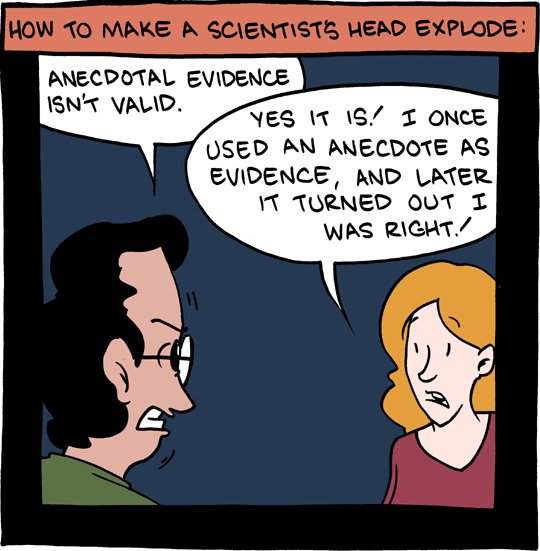
Good storytellers can suck us right in, and for that reason, stories offered as evidence are red flags. |
How to recognise this tactic
Those who use this tactic try to present stories about specific cases or events as supporting evidence. The stories range from personal testimonials, to anecdotes about acquaintances, to tales about unidentifiable subjects.
|
If it isn’t supported by evidence from real-world tests, it isn’t science, it’s a red flag. |
How to recognise this tactic
This tactic shows up when people make claims in the form of bald statements – “this is the way it is” or “this is true” or “I know/believe this” or “everybody knows this” – without any reference to supporting evidence.
‘I had,’ said he, ‘come to an entirely erroneous conclusion which shows, my dear Watson, how dangerous it always is to reason from insufficient data.’
|
Look out for those who portray themselves as the victims of the ‘Big Science’ establishment. This is a red flag. |
How to recognise this tactic
Users of this tactic will try to persuade you that they belong to a tradition of maverick scientists who have been responsible for great advances despite being persecuted by mainstream science. They will compare themselves with scientists they imagine are part of it The most popular draftee is Galileo, and for that reason this tactic is usually known as the Galileo Gambit.
But the fact that some geniuses were laughed at does not imply that all who are laughed at are geniuses. They laughed at Columbus, they laughed at Fulton, they laughed at the Wright brothers. But they also laughed at Bozo the Clown.
|
A claim of scientific proof might seem impressive, but it’s really a red flag! |
How to recognize this tactic
Scammers and deniers use two forms of this tactic:
- they claim that their idea/discovery/product is valid because it has been ‘scientifically proven’
- they refuse to accept someone else’s claim unless it can be ‘scientifically proven’
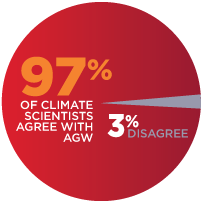
History shows us clearly that science does not provide certainty. It does not provide proof. It only provides the consensus of experts, based on the organized accumulation and scrutiny of evidence.
Naomi Oreskes and Erik M. Conway, American historians, 2010




 Science or not?