
Will there still be scientists if science eventually explains all it can?
 |
This is one of ScienceOrNot’s Hallmarks of science. See them all here. |
In short…
There are aspects of the natural world that science cannot hope to understand, and within those that science can investigate, there remains much to be discovered.
Science lives at its frontiers, looking to the future, aware of the enormous scope of our ignorance.
Dudley Herschbach, American chemist, 1997
Why don’t more scientists become politicians? Scientists change their mind in the face of new evidence. To the media, that gets tagged as the mortal sin of “backflipping”.
|
This is one of ScienceOrNot’s Hallmarks of science. See them all here. |
In short…
No scientific model can ever be considered proven with absolute certainty. There is always a possibility that falsifying evidence will be found. This is unlikely, though, if the model has been supported by multiple independent lines of evidence.
Science advances through tentative answers to a series of more and more subtle questions which reach deeper and deeper into the essence of natural phenomena.
Attributed to Louis Pasteur, French microbiologist.
Why would any scientist want to repeat an experiment that’s been done before?
|
This is one of ScienceOrNot’s Hallmarks of science. See them all here. |
In short…
The scientific community will have greater confidence in a model if the supporting tests are repeated and confirmed by scientists who are independent of the original testers.
Reproducibility—the independent verification of prior findings—is at the core of “the spirit of science”
Ben Santer, Tom Wigley & Karl Taylor, Climate scientists, 2011

Many people like to be guided by gurus. In science, there’s only one guru – the evidence.
|
This is one of ScienceOrNot’s Hallmarks of science. See them all here. |
In short…
The work of scientists, no matter how eminent or influential, is always judged by the quality of their evidence and reasoning , not by their authority.
Nullius in verba (Take nobody’s word for it)
Motto of The Royal Society
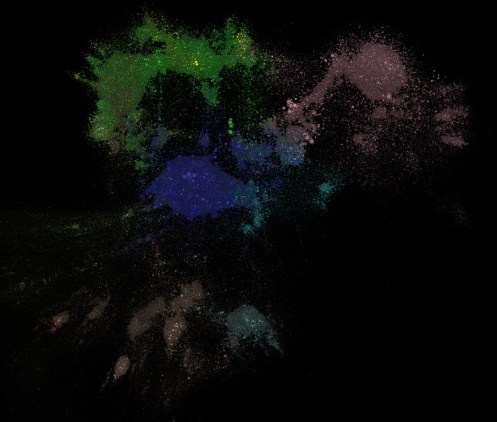
A map of 880,197 scientific papers from the arXiv, by Paperscape.
How is scientific knowledge established?
Scientific understanding builds up through the contributions of countless scientists over time. In most fields of science, there are some scientists who contribute far more than others. They are acknowledged by their peers as eminent scientists. However, in judging their work it’s always the quality of the evidence that matters, not the scientists’ status.
What is the role of authority in science?
There is limited room for authority in science. The scientific community takes particular notice of the work of eminent scientists, who consequently influence the direction taken by scientific research, but they do not have any influence over the data. A model survives or perishes according to the evidence, no matter who proposes it.
Those of us who are not experts in a particular scientific field usually have trouble interpreting the evidence and need to refer to trusted scientists for advice. So how do we know who to trust? It’s important to remember that a scientist can be regarded as an authority only within his or her field. It’s a good idea to be skeptical of any scientists who claim authority outside their fields of expertise.
One way of identifying authoritative scientists is to consult the body that represents scientists working in the relevant field. For example, the Institute of Physics is a worldwide organisation representing physicists. If a scientist is prominent within a field, it’s probably because of a history of presenting reliable evidence and analysis.
Nobel Prize winners are widely acknowledged as being authoritative figures in their field, and there are many other prizes and awards that are less well-known. However, you should be wary of Nobel Disease, the strange tendency of Nobel laureates to embrace pseudoscience in their later years.
Ultimately, scientific authority rests in the evidence. When eminent scientists publish new research, the findings are subject to peer review and replication, just as the work of any other scientist is. It can be challenged by any other researchers in the field, no matter what their status, as long as they have better evidence.
Why science is not based on authority
Scientists are vulnerable to the normal human failings. We all tend to cling to favoured ideas, even when the evidence shows they are on shaky ground. If authority counted for more than evidence, incorrect models could survive when they deserve to be rejected.
Bogus science often relies on the authority of gurus whose pronouncements are not to be questioned.
Examples
- American chemist Linus Pauling is one of the few people to have been awarded two Nobel Prizes, for chemistry (in 1954) and peace (in 1962). He is regarded as one of the most important chemists in history. In the late 1960’s, Pauling began to promote large doses of vitamin C as a way of preventing the common cold. Rather than carry out controlled studies, though, he published a book, Vitamin C and the Common Cold, which described his ideas. In the early 1970’s he began to promote Vitamin C as a treatment for cancer. Despite Pauling’s scientific eminence, the scientific community was very skeptical because of the paucity of supporting evidence for his claims and his avoidance of the peer review process. Continuing trials, although showing some benefits from vitamin C supplements, have not supported Pauling’s optimism (see here, here and here). Pauling is often quoted as an example of Nobel disease.
- Creationists often attack Charles Darwin’s ideas on evolution, imagining that the modern evolutionary model depends on his authority. Darwin found evidence for evolution and presented this in support of his original model in On the Origin of Species in 1859. Since that time, scientists have uncovered vast quantities of new evidence, all supporting an evolutionary model. The specifics of Darwin’s model have been modified and refined, and in many details Darwin was ‘wrong’, but the evolutionary model has been reinforced and survives (see here, here and here).
- Homeopathy is based on ideas of Samuel Hahnemann, formulated in the late 18th century. Hahnemann’s ‘law of similars’ proposed that substances that caused symptom similar to those of an ailment can, when highly diluted, cure that ailment. No evidence has been found to support this law, and trials have consistently shown that homeopathy is no more effective than a placebo (see here and here). Homeopathy continues to rely on Hahneman’s ‘authority’ despite the lack of evidence.
This page reviewed and updated: 2013/10/14
There’s no peak scientific body that judges which models are right and which are wrong. It all depends on peer review and reasoned consensus.
|
This is one of ScienceOrNot’s Hallmarks of science. See them all here. |
In short…
Scientists present new and important findings to the scientific community, where other scientists working in the field scrutinize them.
Peer review keeps the official scientific literature reasonably honest and factually reliable. … But it does not pretend to eliminate error, nor does it guarantee certainty or truth.
The stereotypical lone scientist, beavering away in his laboratory, is no longer with us.
|
This is one of ScienceOrNot’s Hallmarks of science. See them all here. |
In short…
Every scientific model is built up through the collaboration of the scientific community. Those models which survive do so because they fit into and consolidate the fabric of scientific knowledge.
If I have seen farther, it is by standing on the shoulders of Giants.
When you think you’ve got a perfectly good explanation for something, why would you want to dream up another explanation or two?
|
This is one of ScienceOrNot’s Hallmarks of science. See them all here. |
In short…
Scientists must actively address alternatives to their own preferred models. A scientific model is valid only if alternative models have been considered, tested and shown to be wrong.
If there’s something to be explained, think of all the different ways in which it could be explained. Then think of tests by which you might systematically disprove each of the alternatives. What survives, the hypothesis that resists disproof in this Darwinian selection among “multiple working hypotheses,” has a much better chance of being the right answer than if you have simply run the with first idea that caught your fancy.
If you come across data that claims to be completely accurate, should you trust it?
|
This is one of ScienceOrNot’s Hallmarks of science. See them all here. |
In short…
Nothing is certain in science. Every scientific measurement must include an indication of its margin of error.
If you thought that science was certain – well, that is just an error on your part.
In the best scientific trials, the scientists who conduct them know as little as possible.
|
This is one of ScienceOrNot’s Hallmarks of science. See them all here. |
In short…
Randomized controlled trials are used in statistical studies of populations. The random selection process and the ability to ‘double-blind’ the participants mean that non-experimental variables can be neutralized if they cannot be controlled.
The RCT is a very beautiful technique, of wide applicability, but as with everything else there are snags. When humans have to make observations there is always the possibility of bias. To reduce this possibility a modifications has been introduced: the ‘double-blind’ randomized trial.
Sometimes scientists can’t actively probe nature; they just have to take what’s on offer.
|
This is one of ScienceOrNot’s Hallmarks of science. See them all here. |
In short…
Where conditions can’t be controlled, scientists can gather data by observing clues to past events or phenomena occurring within unfolding events.
Scientists engaged in prototypical historical work … are primarily concerned with evaluating hypotheses about particular past events. They cannot reproduce these events in a lab. They can, however, look for present-day traces of them, and search for a smoking gun that unambiguously sets apart one hypothesis as the best among the currently available explanations for the traces thus far observed.




 Science or not?